KLOW Stack
Prices: 80 mg £58.95
Peptide Blends
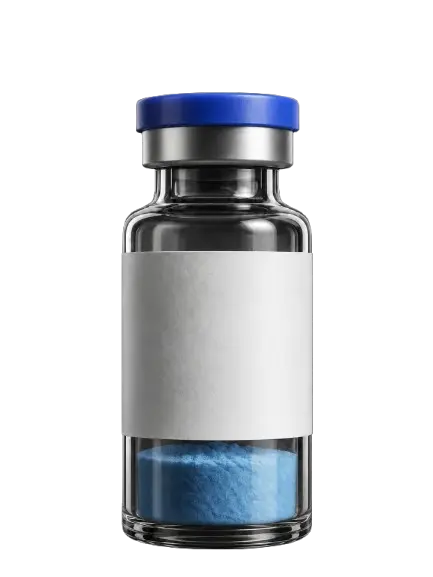
Prices: 80 mg £58.95
Available sizes: 80 mg
The KLOW Stack contains GHK-Cu, TB-500, BPC-157 and KPV in a ratio of about five to one to one to one — roughly 50 mg of the copper peptide and 10 mg of each of the others, giving the 80 mg total on the label. It is the GLOW preparation with one further component.
That fourth component is the reason the preparation exists separately, so it is worth understanding on its own. KPV is a tripeptide — lysine, proline, valine — which are the last three residues of α-MSH, the hormone that instructs pigment cells. Detached from the rest of the hormone it loses the pigmentation activity entirely and retains an anti-inflammatory one.
What makes KPV unusual is that it appears to act inside the cell rather than at a surface receptor. It is small enough to be carried in by transporters intended for the products of protein digestion, and published work concerns its effect on NF-κB — the protein complex that switches on inflammatory genes as a set. Adding it to a repair preparation is an argument about the inflammatory context in which repair happens.
The inflammatory switch: KPV is studied for its effect on the master control of inflammatory gene expression. Acting on the switch rather than on one output is what makes its reported effect broad.
Copper for matrix enzymes: GHK-Cu makes up five parts of the eight and carries copper, which the enzymes that cross-link collagen cannot function without.
Cell movement and vascular signalling: TB-500 relates to the actin machinery that lets cells migrate; BPC-157 is studied for the signals that extend blood supply into damaged tissue.
Four components, more interactions: Each additional compound multiplies the number of possible interactions and reduces what any single observation can be attributed to. That is a real cost of a broader preparation.
Inflammation and repair are not separate processes and they are not simply opposed. An inflammatory response clears damaged material and recruits the cells that rebuild, and it is required. Sustained inflammation, on the other hand, prevents resolution, and tissue that stays inflamed does not finish repairing. The argument for the fourth component is about that balance rather than about suppression.
The rest of the reasoning follows the three-component preparation: structure needs enzymes that need copper, remodelling needs cells that can move, and both need a blood supply. Adding an anti-inflammatory component is an argument that the environment in which those processes occur matters as much as the processes themselves.
As with every blend, the argument is a hypothesis about the mixture and the evidence concerns the parts. Four compounds in fixed proportion cannot be varied independently, so a study using this preparation is asking one question about one mixture. That is a legitimate question and a narrow one.
The components have individual literatures of varying strength: established copper chemistry for GHK-Cu, well-characterised actin biology behind thymosin β4, extensive rodent work for BPC-157 from a limited number of groups, and independent cell and animal work for KPV in intestinal inflammation models.
The four components have individual literatures of differing strength, and the preparation as a whole has not been compared against them. It is supplied for laboratory research only. What it offers is the four together in fixed proportion, with the anti-inflammatory component that distinguishes it from the three-peptide blend, and every component is supplied separately for the comparison.
GLOW Stack is this preparation without KPV, which makes the two a direct comparison of what the fourth component is proposed to add. Wolverine Stack is the two-component subset.
KPV and GHK-Cu are supplied individually, and any study attributing an effect to either will need them that way.
Certificates of Analysis are published for tested products and batches. A certificate is a batch-specific record: it reports what was measured, by which method, on a stated date, against a batch identifier. It is evidence about the sample analysed at the time of analysis, and it is silent on attributes it does not list and on what has happened to the material since.
The batch number is the field that connects the document to a physical vial. Where the identifier on a vial does not appear on a certificate, the certificate does not describe that vial, however thorough the analysis behind it was. Batch records can be searched directly, and the guides below explain what each field establishes and what it does not.
Supplied for laboratory research use only. Not for human or veterinary use.