GHK-Cu
Prices: 50 mg £17.95 · 100 mg £31.95
Dermal ResearchCAS 89030-95-5
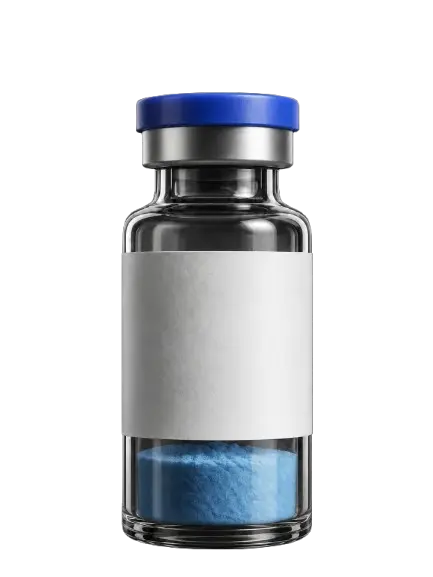
Prices: 50 mg £17.95 · 100 mg £31.95
Available sizes: 50 mg, 100 mg
GHK-Cu is three amino acids — glycine, histidine and lysine — holding a single copper ion. The peptide part was identified in human blood plasma in 1973, and the discovery that made it interesting was that its concentration falls steeply with age: roughly 200 nanograms per millilitre at twenty, around 80 by sixty. A naturally occurring molecule that declines on that scale is an obvious subject for research into how tissue changes over a lifetime.
The copper is not incidental, and this is the single most important thing to understand about the molecule. Copper is essential to several enzymes that build connective tissue, but free copper in solution is toxic — it drives reactions that damage cells. The body therefore never transports copper loose; it is always held by a carrier. The GHK sequence binds copper with almost exactly the affinity needed to accept it from one carrier protein and hand it to another, which is why it is described as a copper transport peptide rather than a copper supplement.
That dual nature is what distinguishes it from other peptides studied in skin research. Most are examined for signalling alone. This one delivers a metal that specific enzymes cannot function without, and the research question is about both the message and the material.
Copper delivery to enzymes: Lysyl oxidase, the enzyme that cross-links collagen fibres into a strong network, requires copper at its active site to work at all. A molecule that can hand copper to enzymes like it is studied for the supply of a component, not only for a signal.
Collagen production and breakdown: Connective tissue is continuously built and dismantled. Cell-culture work has measured both sides of that balance in fibroblasts — the cells that produce collagen — which is a more informative question than production alone.
Gene expression profiling: One of the more striking findings is how broad its effect appears in gene-expression screens, where exposure altered the activity of a large fraction of measured human genes. Whether that breadth is meaningful or a general stress response is actively debated.
Decline with age: Its measured fall in plasma across a lifetime is unusual among peptides in being well documented in humans. That observation is what originally drove interest, and it remains the reason it appears in ageing-related research.
Collagen is the main structural protein of connective tissue, and on its own it is not strong. Individual collagen molecules only become a load-bearing fabric once they are chemically stitched to one another, and the enzyme doing that stitching, lysyl oxidase, has a copper ion at its core. Without copper, the enzyme is inert and the collagen laid down never gains its strength. This is the concrete link between a trace metal and the mechanical properties of tissue.
The extracellular matrix — the scaffold of collagen, elastin and water-binding molecules that cells live inside — is not built once and left. Cells add to it, enzymes cut it back, and the composition shifts constantly. Research on GHK-Cu has examined both directions of that turnover, including the enzymes that break the matrix down and the natural inhibitors that restrain them. A compound influencing the balance rather than one side of it would behave differently from one that simply increases output.
The broader gene-expression findings are the most striking and the least settled. Exposing cultured cells to the peptide has been reported to shift the activity of thousands of genes, which is a large effect by any measure, though large-scale changes in a dish are common and a result that size is as consistent with a general cellular response as with a specific one. Establishing which it is, and what it means in intact tissue, is an active line of work.
GHK-Cu is one of the better-characterised peptides in skin and connective tissue research. Its presence in human plasma, its copper-binding constant and its measured decline with age have been reproduced independently since the 1970s, and the requirement for copper in lysyl oxidase — the enzyme that cross-links collagen into a load-bearing network — is established biochemistry.
Most functional work is in cell culture and animal models, with a smaller body of human study in cosmetic settings. It holds no medicines approval and is supplied for laboratory research only. What makes it a strong research compound is that the chemistry underneath it is settled: the copper binding is measured, the enzymes that depend on it are known, and an experiment can be designed around both.
The closest comparison is AHK-Cu, a different copper-binding tripeptide with alanine in the first position rather than glycine. The two are studied side by side precisely because the copper chemistry is shared and the peptide is not, which makes them a natural pair for asking which half of the molecule an observed effect belongs to.
Both appear in multi-peptide preparations: the GLOW Stack and the KLOW Stack each combine GHK-Cu with compounds studied through unrelated mechanisms. SNAP-8 is the other peptide widely used in skin research and has nothing in common with it mechanically, interfering with nerve signalling rather than with the tissue itself. Grouping compounds in one vial is a convention of research supply rather than a finding about them.
Certificates of Analysis are published for tested products and batches. A certificate is a batch-specific record: it reports what was measured, by which method, on a stated date, against a batch identifier. It is evidence about the sample analysed at the time of analysis, and it is silent on attributes it does not list and on what has happened to the material since.
The batch number is the field that connects the document to a physical vial. Where the identifier on a vial does not appear on a certificate, the certificate does not describe that vial, however thorough the analysis behind it was. Batch records can be searched directly, and the guides below explain what each field establishes and what it does not.
Supplied for laboratory research use only. Not for human or veterinary use.