Bacteriostatic Water
Prices: 3 ml £5.95 · 10 ml £11.95
Laboratory Supplies
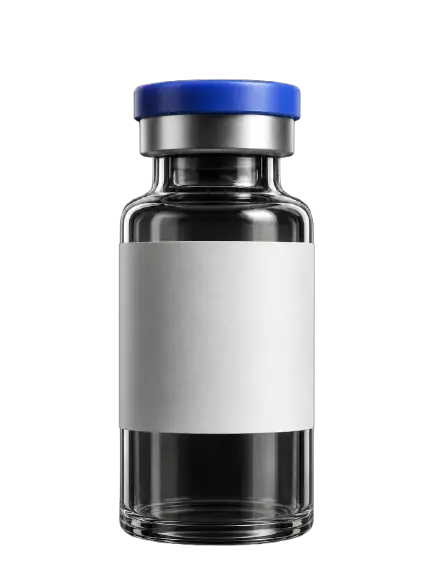
Prices: 3 ml £5.95 · 10 ml £11.95
Available sizes: 3 ml, 10 ml
Bacteriostatic water is water for injection with benzyl alcohol added at nine parts per thousand. Everything about how it is used follows from that one ingredient, so it is worth understanding what the preservative does and, just as importantly, what it does not.
Benzyl alcohol is bacteriostatic rather than bactericidal — the distinction is in the name. It does not sterilise anything and it will not rescue a contaminated solution. What it does is prevent the growth of organisms that arrive afterwards, which is why a sealed vial of it can be entered more than once while plain sterile water cannot. Sterile water is sterile until the moment its seal is broken, and after that any organism introduced has an unimpeded medium to multiply in.
Its pH sits in the mildly acidic to neutral range, which suits most lyophilised peptides. Peptides are supplied freeze-dried because they are far more stable as a dry powder than in solution; once a solvent is added the clock starts, and what the solvent contains determines how fast it runs.
Bacteriostatic, not sterilising: It inhibits growth rather than killing what is already present. A solution contaminated at the point of preparation stays contaminated.
Why multi-entry is possible: The preservative is what allows a vial to be entered more than once without the contents becoming a culture medium. Plain sterile water offers no such protection.
Suitable for most lyophilised peptides: Its near-neutral pH dissolves the majority of peptide powders without difficulty, which is why it is the default choice for laboratory reconstitution.
Not universal: Some peptides are poorly soluble at neutral pH and need an acidic solvent instead. Cloudiness or visible particles after adding water usually means the wrong solvent for that peptide.
The choice between solvents is decided by the peptide, not by preference. Most lyophilised peptides dissolve readily in bacteriostatic water and it is the ordinary choice. A peptide that will not go into solution at near-neutral pH usually needs an acidic solvent, which is what dilute acetic acid is for. Work in cell culture, where ionic strength and buffered pH matter to the cells rather than to the peptide, generally calls for phosphate-buffered saline instead.
The underlying chemistry is charge. Amino acid side chains gain and lose protons as pH changes, and a peptide is least soluble at the pH where its positive and negative charges balance. Move the pH away from that point in either direction and the molecule carries a net charge, water molecules arrange around it, and it dissolves. That is the whole of why an acidic solvent rescues a peptide that plain water will not take.
Acetic Acid Water is the acidic alternative for peptides that resist dissolving at neutral pH, and Phosphate Buffered Saline is the buffered, physiological-strength option used where the cells matter as much as the compound.
Certificates of Analysis are published for tested products and batches. A certificate is a batch-specific record: it reports what was measured, by which method, on a stated date, against a batch identifier. It is evidence about the sample analysed at the time of analysis, and it is silent on attributes it does not list and on what has happened to the material since.
The batch number is the field that connects the document to a physical vial. Where the identifier on a vial does not appear on a certificate, the certificate does not describe that vial, however thorough the analysis behind it was. Batch records can be searched directly, and the guides below explain what each field establishes and what it does not.
Supplied for laboratory research use only. Not for human or veterinary use.