Acetic Acid Water
Prices: 3 ml £5.95 · 10 ml £9.95
Laboratory Supplies
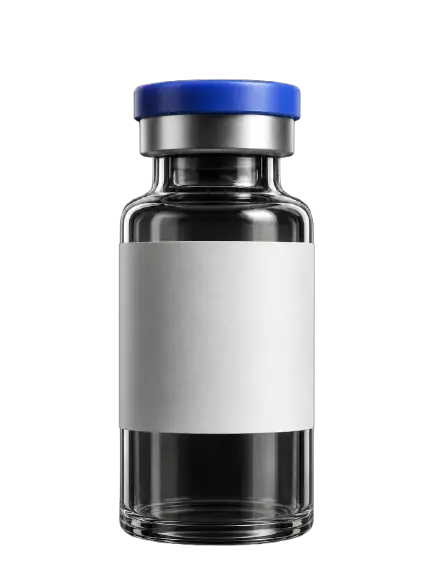
Prices: 3 ml £5.95 · 10 ml £9.95
Available sizes: 3 ml, 10 ml
Acetic acid water is sterile water with a small proportion of acetic acid — the same acid found in vinegar, at a concentration far below it. It exists for one purpose: dissolving peptides that will not go into solution in plain or bacteriostatic water.
That failure is common and it has a specific cause. Every peptide has a pH at which its positive and negative charges exactly cancel, called the isoelectric point. At that pH the molecule carries no net charge, water has nothing to grip, and the peptide is at its least soluble — it stays as visible particles or produces a cloudy suspension that never clears. Some peptides have an isoelectric point close to neutral, which is precisely where ordinary water sits.
Lowering the pH solves it. In acidic conditions the basic side chains pick up protons, the molecule carries a net positive charge, water arranges around it and it dissolves. Nothing about the peptide has changed; the solvent has simply moved away from the pH at which it is least willing to dissolve.
For peptides with a near-neutral isoelectric point: These are the ones plain water leaves cloudy. Shifting the pH is the standard laboratory answer and the reason this solvent is kept alongside the others.
Acetic acid is volatile: It evaporates readily, which is why it is the conventional choice in peptide chemistry — a solution can be freeze-dried again and very little acid is left behind.
Charge, not aggression: The dilution is mild. It is not breaking anything down; it is moving the pH far enough from the peptide's neutral point that water can solvate it.
Usually a first step: Standard practice is to dissolve in the acidic solvent and then dilute into whatever the experiment requires, rather than working at low pH throughout.
Most lyophilised peptides dissolve without difficulty in bacteriostatic water, which is the ordinary starting point. This solvent is the answer when that does not work — a powder that stays visible, or a solution that remains cloudy after gentle mixing, generally indicates a peptide whose isoelectric point is too close to neutral. Phosphate-buffered saline is a different kind of choice again, used where the ionic strength and pH matter to a biological system rather than to the peptide.
Two further points are worth knowing. Vigorous shaking is a poor remedy for a peptide that will not dissolve: it introduces air, denatures some peptides at the liquid surface and rarely improves solubility. And a peptide that dissolves only in acid will often come back out of solution when diluted into a neutral buffer, which is a property of the molecule rather than a fault of the preparation.
Bacteriostatic Water is the default solvent and the right first choice for most peptides. Phosphate Buffered Saline is the buffered option for work where a physiological pH and salt concentration are part of the experiment.
Certificates of Analysis are published for tested products and batches. A certificate is a batch-specific record: it reports what was measured, by which method, on a stated date, against a batch identifier. It is evidence about the sample analysed at the time of analysis, and it is silent on attributes it does not list and on what has happened to the material since.
The batch number is the field that connects the document to a physical vial. Where the identifier on a vial does not appear on a certificate, the certificate does not describe that vial, however thorough the analysis behind it was. Batch records can be searched directly, and the guides below explain what each field establishes and what it does not.
Supplied for laboratory research use only. Not for human or veterinary use.